









NEWS
2026.10.10
'India Mela' held at MERIKEN Park in Kobe
Dates: October 10 (Saturday) ~ October 12 (Monday, holiday)
Admission: Free
Location: Meriken Park, Kobe
The largest Indian festival in western Japan, 'India Mela,' will be held.
You can experience various Indian traditional Music and Dance events, Indian handicrafts, and local food and drinks.
Admission is "free." They will warmly invite you to participate in this event.
For more details, please see the following website.
https://india-mela.com/
2026.9.26
A Celebration Festival for the Adoption of Hindi as an Official Language at Indian Clube in Sannomiya, Kobe, on September 26, 2026
To commemorate the day Hindi was officially designated as the official language of the Republic of India on September 14, 1950, celebrations are held around that day in the cities where the Indian embassy and/or general consulates are located.
In Kansai, a celebration will be held at the India Club in Kobe on Saturday, September 26, starting at 6:00 PM. Our company representative is also scheduled to participate in this India-related event as one of supporters of the Kansai Japan-India Cultural Society.
2025.5.7
BRAIX IVS
The annual conference of Kansai Japan India Cultural Society will be held at our NAMBA office in the evening of May 8, 2025.
The meeting is scheduled to discuss the Account Settlement on the association’s 2024 activity, and Yearly Programs on 2025, and the related budget, etc.
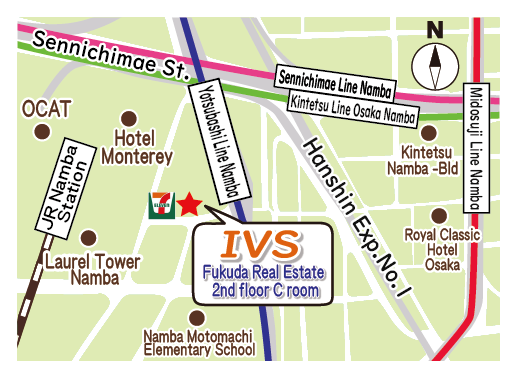
The meeting place is located as follow.
◆ At the meeting room at Braix Corpration.
◆ TEL:06-6684-9965
◆ Address: Room No.2c, Motomachi 1-2-17, Naniwa-Ku, Osaka City
(2nd Floor in Namba Building of “FUKUDA Real Estate”.)
■ There is a SEVEN ELEVEN shop at the 1st floor.
■ There is a “IVS” ad in front of the shop.
■ The building sits diagonally the entrance of APA.Tower (NAMBA EKIMAE) Hotel.
■The nearest stations are:
OSAKA NAMBA
(Midosuji Line/Yotsuhashi Line)
OSAKA NAMBA
(Hanshin-Kintetsu Line)
JR NAMBA
(Jr Line)
OCAT NAMBA
(various buses line)
2024.12.13
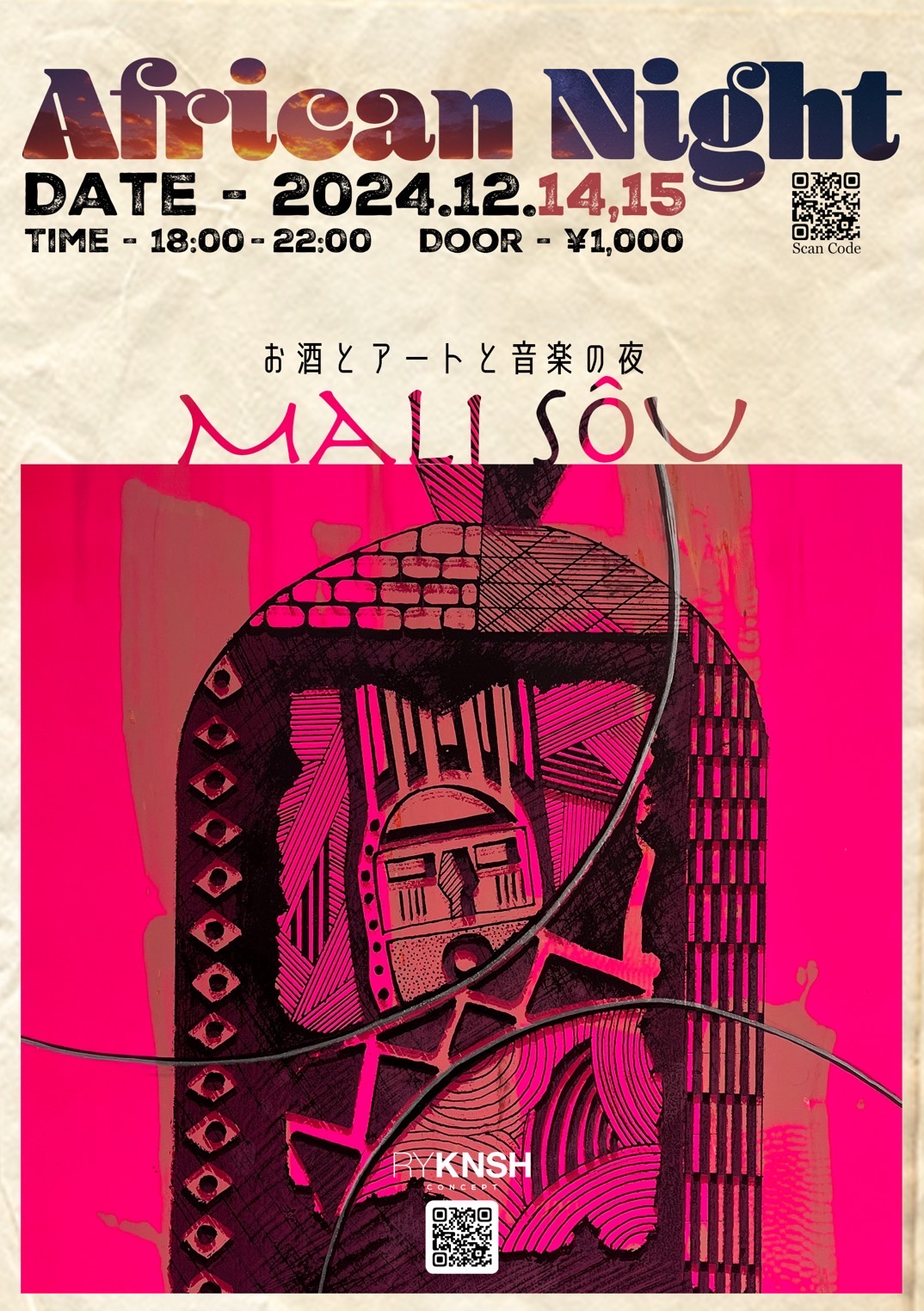
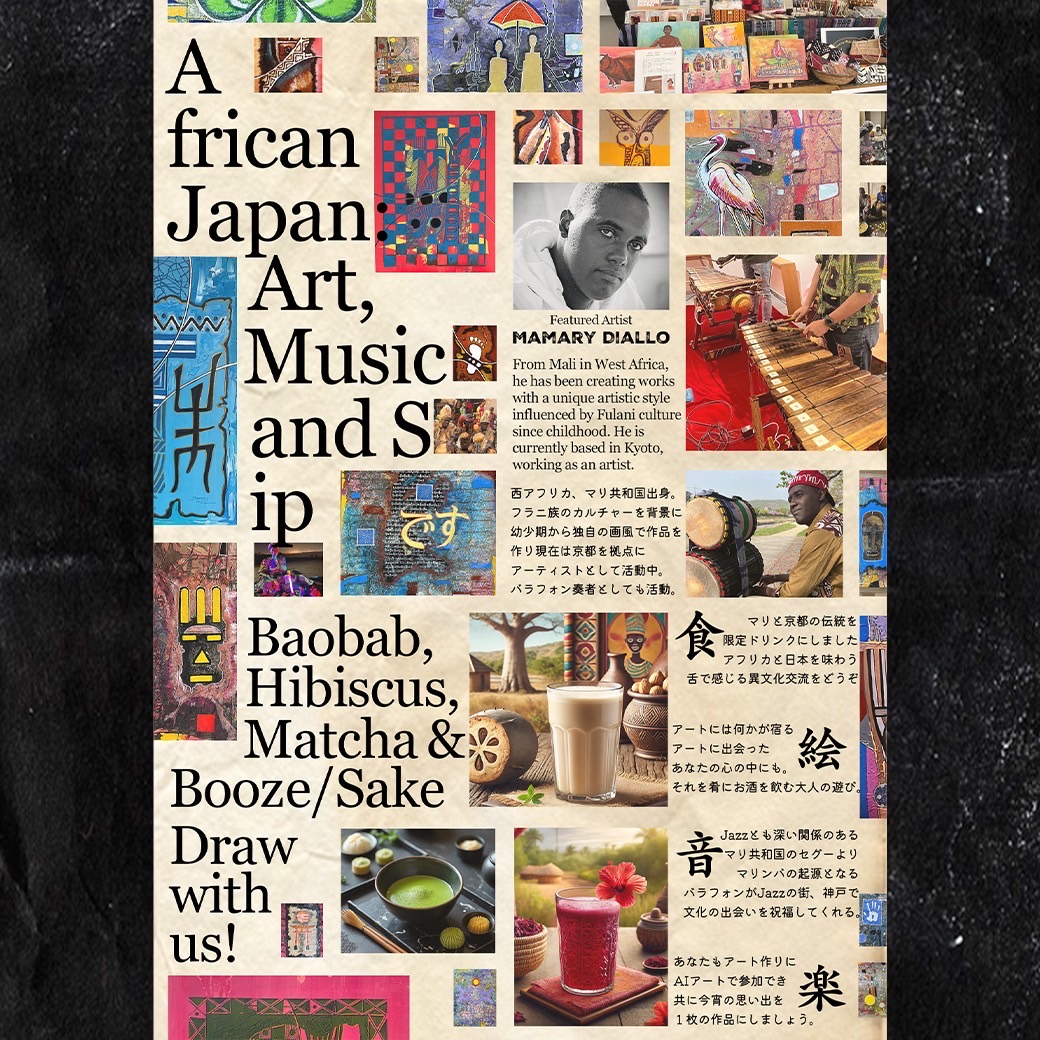
Our friend, MAARI-san, who came from Mari in Africa, has been acting as an artist and musician in Kyoto.
He will hold very unique event in Sannomiya, Kobe on this weekend. Please participate with your friends
and enjoy his painted art, his playing music and drinking.
Place: KIta-Nagasadori 3 Chome−3−16,Chuo-Ku, Kobe-City
(TOR FOREST BLDG 1F)
Day: December 14(SAT), and 15(SUN)
Hours: 18:00-22:00
Admission Fee:\1000.-
2024.7.7
"Sari" maker in Kyoto asks you to provide unique designs for his survival.
Design Competition for Kyoto Yuzen Sarees 2024
2024.5.1
【Notice on No- Use of FAX】
1.As of May 19, 2024, we will not use fax message as the communication tool between our clients and us. After May 20, 2024, we will use only the E-mail, instead of the fax message.
The reasons are;
1) Some senders have sent us the important fax message by mistakes.
2) We also might have sent our message through fax to wrong addresses.
2. After the May 20, 2024, we will use the current fax numbers as telephone numbers for the English language communication only.
Your kind understanding and cooperation would be appreciated.

SHOCHU
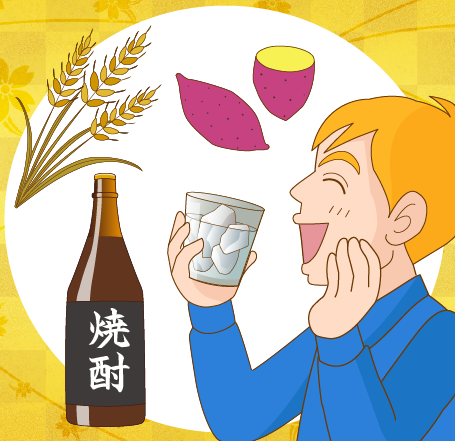
Seishu or Shochu?
Nihonshu is called Japanese sake in English. Nihonshu has another name, Seishu, which actually looks clear and pure as its Japanese meaning of Seishu.
Lots of people from foreign countries pronounce Sake into Saki. However, if they live in Japan long time, they are accustomed to Japanese pronunciation and may be able to pronounce Japanese properly. Naturally, some foreign Sake enthusiasts say that they should pronounce it as SAKE instead of SAKI.
If he is a Shochu-geek, he might even point out that Shochu could be called Shocchu with doubled consonant somewhere in Kyushu area. If some foreigners are "fitted" with Shochu, they seem to be outstanding geeks. I am very anticipating such Japanese alcoholic geeks being publicity agents to the world.
By the way, I mentioned Shochu as “Japanese national sake “last time. But, when it comes to "Japanese sake", it would be overwhelming for foreigners to think that sake is a representative of alcohol in Japan. In other words, many people including Japanese and foreigners think that the alcohol that represents Japan is sake (Nihonshu or Seishu).
However, it is wrong and misunderstanding. In reality, Shochu is overwhelmingly higher than Sake (Nihonshu or Seishu) in terms of domestic production volume. In other words, the sake that represents Japan is actually Shochu, not Sake(Nihonshu or Seishu).
The National Tax Agency (NTA) publishes detailed statistics for alcoholic sales every year. Since the production of Shochu reversed that of Sake (Nihonshu or Seishu) in 2001, the difference in quantity between the two categories, has only widened. According to the latest Annual Report (2019) by National Tax Agency, when converted fairly to alcohol volume, the volume of Shochu is 728,000 Kl, while that of Nihonshu (Seishu) is 392,000 Kl. Namely Shochu is about 1.85 times of Sake (Nihonshu or Seish).
Therefore, there is clear evidence to call Shochu as a Japanese National Sake. Japanese national Sake is Shochu, which we must appeal to foreigners and the markets strongly and proudly. And we should try to spread the many featured good points of Shochu to the world.
Visa
/Immigration
/Jobs
Entertainment
Tour Spots
About Us
Naniwa-Ku, Osaka-City, Osaka Pref.
(FUKUDA Realty. NAMBABldg)
ZIP:556-0016
Location
TOPICS
by Mr. Iqubal Kashif, a comrade of our company
Mr.Iqubal Kashif, a former our IVS staff, in Delhi, India, has mailed us wonderful news.
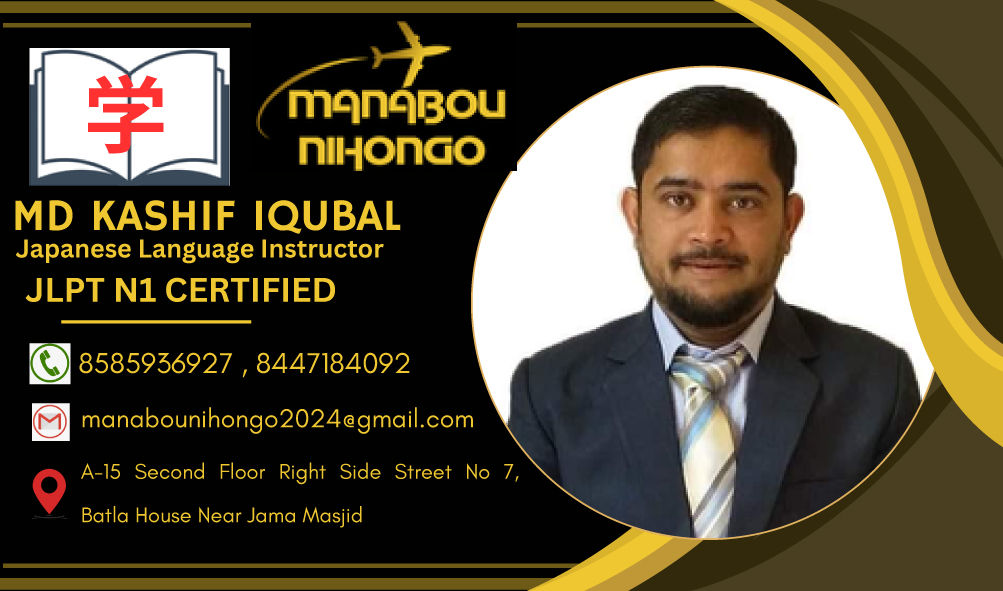
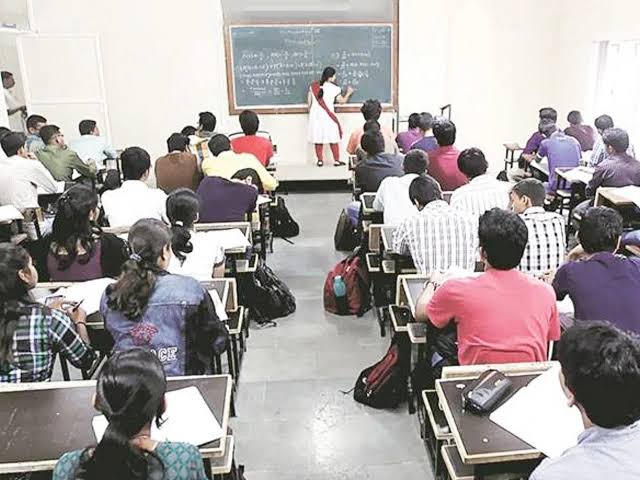
Taking advantage of the qualification of the Japanese Proficiency Test Level 1 (JLPT 1) obtained in Japan, he has opened a Japanese language class in Delhi city, India. The name of the class is "MANABOU NIHONGO" – Let’s Study Japanese. This Japanese class has been established for the purpose of teaching Japanese to Indian students in Delhi.
There are three features of the course. The first; It covers any grade from Japanese beginners to advanced learners. The courses can be selected according to the student's level of Japanese acquisition.) The second; It is for computer engineers and teaches the “Japanese Engineering Terminology" and "The Japanese Phrase”. The third; It educates generally on "Japan Culture and Business Customs" for non-engineers.
In particular, I think it an excellent idea the establishment of a course to teach Japanese engineering terms to computer science students. This is because the acquisition of special terminology used in specialized fields is a very high and thick barrier for foreigners. Most of the foreign engineers have to spend the time and cost on the peculiar engineering Japanese, adding the survival and daily Japanese. I assume this Japanese language school has a hidden goal of becoming a bridge between India and Japan in the field of computer science.
Mr. Iqubal Kashif, the chief of this school, had worked at our company in Osaka for several years. During the Corona period, when business is slow, he had been receiving special Japanese training from the staff for about 2 hours early in the morning every day. On holidays, he went to Japanese libraries to study Japanese constantly. And he targeted the "Japanese Proficiency Test Level 1" (JLPT1 I). As a result, he finally passed the the test and get the certificate of “JLPT 1”.
After that, he used his the “JLPT 1” qualifications to work as a "multilingual interpreter" at Narita Airport in English, Arabic, Urdu, Hindi and Japanese. However, his wife in his home country of India gave birth, so he returned to India. While working in Japanese company in Delhi, I tried to realize the opening of a Japanese language school, and finally has reached the "MANABOU NIHONGO" class.
We plan to collaborate with Mr. Iqubal Kashif’s Japanese language school in Delhi to develop close relationship with excellent Indian human resources, and contribute to business exchanges between Japan and India through them. We will inform you of the progress about this plan on this website as appropriate.
change the history.